

When it comes to tire maintenance, most drivers are careful about avoiding underinflation. We’ve all heard how driving on low-pressure tires can hurt fuel economy, slow down handling, and chew through tread faster. But what about the opposite problem? Are overinflated tires safe to drive on?
The short answer: No. The dangers of overinflated tires can be just as serious as underinflation — sometimes more so. An overinflated tire may give you a slightly firmer ride or even a tiny boost in fuel economy, but it comes with trade-offs in safety, traction, and comfort that simply aren’t worth it.
In this guide, we’ll explore what overinflation really means, the dangers it poses, common causes, and how to keep your tire pressure exactly where it should be.
What Does “Overinflated” Mean?
Every vehicle comes with a manufacturer-recommended PSI (pounds per square inch) for the tires. This isn’t a suggestion — it’s a tested number designed to balance safety, performance, and longevity. You can find your vehicle’s PSI in three places:
- The owner’s manual
- A sticker on the driver’s side door jamb
- Sometimes inside the fuel door
If you pump your tires above this PSI — even by 3–4 pounds — your tires are technically overinflated.
Example: If your car’s recommended pressure is 35 PSI, inflating to 42 PSI is overinflating. While a couple of extra PSI might not cause immediate issues, running significantly over the recommendation for long periods can be risky.
Why Some Drivers Overinflate Their Tires
There are a few common reasons why drivers end up with overinflated tires:
1. Confusing Max PSI with Recommended PSI
The “maximum PSI” printed on the tire’s sidewall is not the number you should inflate to. It’s the maximum safe pressure the tire can handle — not the optimal number for daily driving.
2. Chasing Fuel Economy
Some believe that overinflating reduces rolling resistance and improves miles per gallon. While it might give a tiny MPG boost, the trade-off in safety and ride quality makes it a bad deal.
3. Compensating for Leaks
If a tire has a slow leak, some people overinflate to “buy time” before they have to refill or repair it. This actually increases the risk of a dangerous blowout.
4. Seasonal Misjudgment
Air expands in heat and contracts in cold. Drivers sometimes overinflate in winter to offset cold pressure drops, forgetting that warmer days will push the PSI well above the safe range.
Dangers of Overinflated Tires
Driving with too much air in your tires can cause:
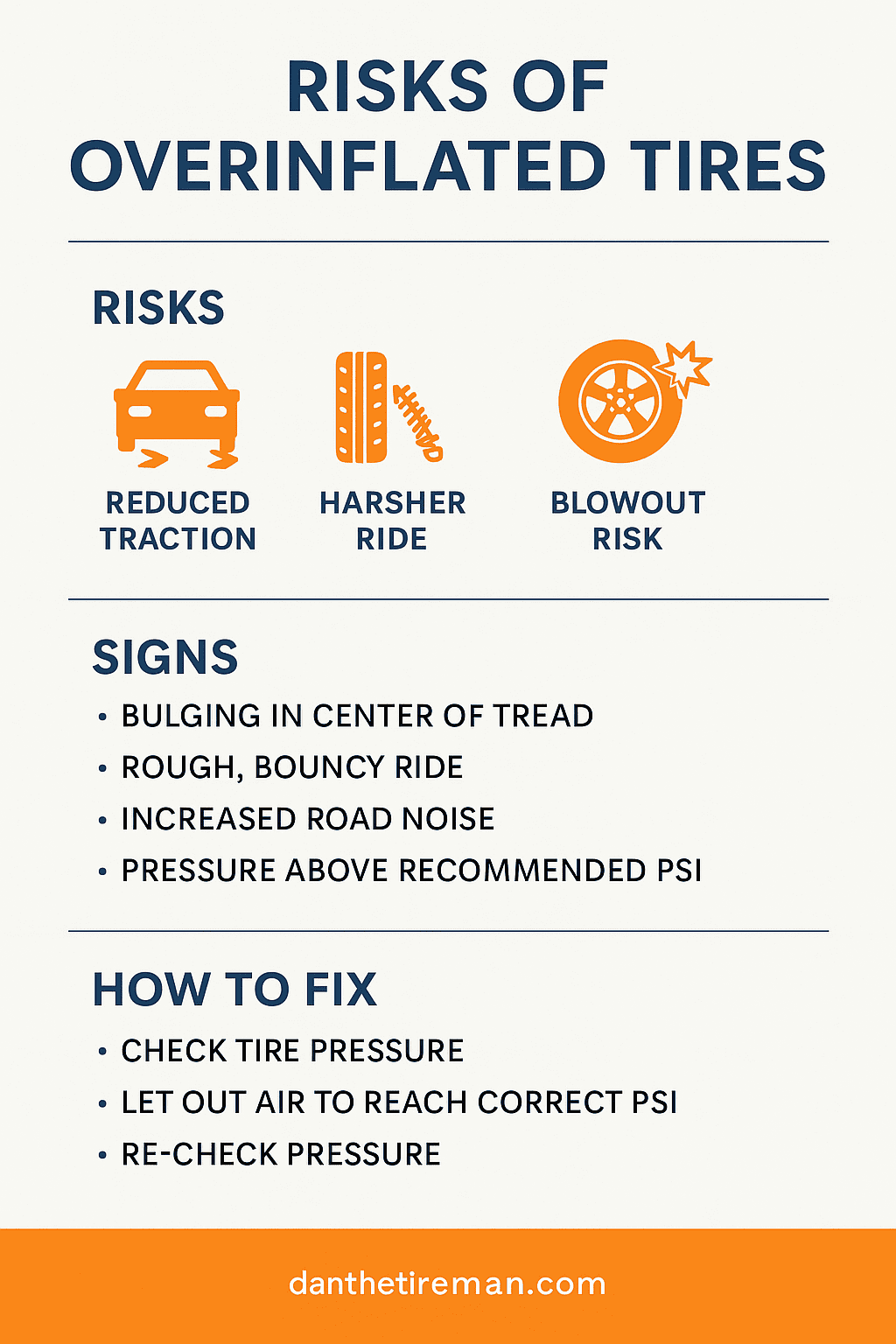
1. Reduced Traction
When you overinflate a tire, the center tread bulges, reducing the amount of rubber touching the road. This smaller contact patch means less grip — especially dangerous on wet or icy surfaces.
2. Harsher Ride
Extra air pressure stiffens the tire, making every bump and pothole feel more jarring. This isn’t just uncomfortable — it can wear out suspension components faster.
3. Higher Blowout Risk
Overinflated tires are more rigid, making them more likely to burst when they hit potholes, curbs, or debris.
4. Uneven Wear
With overinflation, the center tread wears much faster than the edges. This can cut your tire’s life span in half, costing you money sooner.
5. Poor Braking Performance
Since less tread is in contact with the road, stopping distances increase. This is especially dangerous in emergencies or bad weather.
Real-World Example
Imagine you’re driving on the highway in summer with your tires inflated to the max sidewall PSI — say 44 PSI. The pavement is hot, the air temperature is 90°F, and after an hour of driving, your tire pressure naturally increases by 3–4 PSI from heat expansion. Now you’re running at 47–48 PSI, well above the intended design range. Hit a pothole at 65 mph, and you’re at much higher risk for a blowout.
Signs Your Tires May Be Overinflated
Not sure if you’ve got too much air? Look for:
- Center tread more worn than edges
- Rough, bouncy ride quality
- Increased road noise
- “Twitchy” steering response
- A reading above the recommended PSI when checked cold
How Overinflation Affects Handling
An overinflated tire doesn’t just feel different — it changes the way your car behaves:
- Sensitive steering: Feels twitchy and harder to control, especially in wind.
- Reduced grip: Less surface area on the road, worse in rain or snow.
- Higher hydroplaning risk: Less tread in contact with the road means water isn’t displaced as well.
How to Keep Your Tire Pressure in the Safe Zone
1. Check Monthly (at Minimum)
Tire pressure naturally changes with temperature and time. In colder months, PSI can drop 1–2 pounds for every 10°F drop in temperature.
2. Use a Reliable Gauge
Gas station gauges are often off by several PSI. Invest in a digital or high-quality manual gauge.
3. Check When Cold
Readings are more accurate before you’ve driven or after your car has been parked for at least 3 hours.
4. Know the Right Number
Always go by the manufacturer’s recommended PSI, not the number on the tire sidewall.
Overinflation vs. Underinflation: Which Is Worse? Both are bad, but in different ways:
- Underinflation generates more heat, causes sidewall flexing, and leads to rapid tread wear — it’s the bigger culprit in tire failures.
- Overinflation reduces traction, comfort, and increases blowout risk on impact.
For most drivers, underinflation is more destructive long-term, but overinflation is equally dangerous for handling and safety.
Seasonal Adjustments: A Must-Do
Temperature plays a big role in tire pressure:
- Summer: Hotter weather can add 2–4 PSI to your tire pressure by midday.
- Winter: Colder air lowers PSI, tempting drivers to overcompensate.
The best approach? Adjust seasonally but always within the recommended PSI range.
How to Correct Overinflated Tires
If you’ve put in too much air:
- Check the correct PSI in your manual or on the door jamb sticker.
- Release air slowly using the valve stem pin.
- Recheck PSI to confirm accuracy.
FAQ: Overinflated Tire Safety
Q: Can I drive short distances on slightly overinflated tires?
A: If you’re only 1–2 PSI over, you can usually correct it at your next stop without major risk. Anything beyond that should be fixed immediately.
Q: Will overinflating my tires save gas?
A: Not enough to matter. Any fuel savings are minimal compared to the safety risks and increased tire wear.
Q: Can my TPMS warn me about overinflation?
A: Most TPMS systems are designed to detect underinflation, not overinflation, so you’ll need to check manually.
Final Thoughts: Are Overinflated Tires Safe?
Overinflated tires are not safe for long-term driving. They reduce traction, create a rough ride, increase blowout risk, and cause uneven wear. The safest thing you can do is keep your tires at the manufacturer’s recommended PSI.
Proper tire pressure will:
- Extend your tire lifespan
- Improve safety and control
- Boost fuel efficiency
- Reduce your risk of roadside emergencies
Need New Tires? We’ve Got You Covered
If your tires are worn from overinflation or just need replacing, Dan the Tire Man makes it easy. We offer:
- Brand new passenger, light truck, and commercial tires
- $0–49 out of pocket
- No hard credit check
- Free shipping
Explore our passenger and light truck tire selection, check out our easy lease-to-own tire program, or browse our motorcycle tires.
Your tires keep you connected to the road — make sure they’re inflated correctly and ready for anything.